iPad
Apple's 10.9-inch iPad with Apple Pencil and Magic Keyboard Folio support, starting at $449.
Should You Buy an Entry-Level iPad?
The iPad is Apple's most affordable and most popular tablet, and the 10th-generation model features the A14 Bionic chip, an updated design with flat sides and a range of color options, a larger display, a USB-C port, and more, with prices that start at $449.
Introduced in October 2022, the 10th-generation iPad is nearing the end of its product cycle and is expected to be refreshed in late 2024. With the refreshed design and A14 chip, however, the 2022 iPad is a tablet that's going to last for years, so if you need a tablet now and don't want to wait, it's still an okay time to purchase. If you are concerned about having the latest technology, you should wait.
For those looking for something cheaper, the ninth-generation iPad from September 2021 remains on sale for $329 -- $120 less than the tenth-generation iPad. This device sports an older design with a smaller display, a Lightning port, and the A13 Bionic chip.
The iPad is Apple's most inexpensive iPad model for those who want a balance of features and affordability, but users looking for a smaller iPad with better specifications should consider the iPad mini, which starts at $499. On the other hand, for an iPad with better specifications, there is the $599 iPad Air, which offers the M1 chip, features like Stage Manager, and improved display technologies.
Apple's 2022 10th-Generation iPad
Contents
Apple introduced the 10th-generation iPad in October 2022, featuring a large number of improvements and upgrades over the previous-generation model, including the addition of the A14 Bionic chip, a new USB-C port, a larger 10.9-inch Liquid Retina display, a higher-quality 12-megapixel rear camera, and more, all in a new design and a range of bright color options.
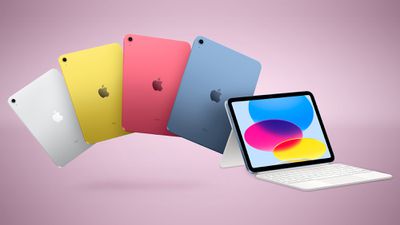
The 10th-generation iPad adopts the squared-off all-display design of the iPad mini and iPad Air and comes in Silver, Blue, Pink, and Yellow. Instead of a Home button, Touch ID moves to the Top button of the iPad, much like the iPad Air, and the front-facing camera moves to the landscape edge of the device for the first time on an iPad for a better video calling experience.
Like the iPad Air, the 10th-generation iPad offers a 10.9-inch Liquid Retina display with a resolution of 2360 by 1640 pixels, 500 nits of brightness, and True Tone technology, but it does not have some of the bells and whistles of other iPad displays such as an anti-reflective coating.
The iPad now features Apple's A14 Bionic chip, which was first introduced with the fourth-generation iPad Air and iPhone 12 lineup in 2020. While it is slower than the M1 chip in the iPad Air, it is around 20 percent faster than the A13 Bionic chip in the previous-generation entry-level iPad.
The new iPad also gets a significantly improved 12-megapixel camera with support for 4K video recording, Wi-Fi 6 support, and 5G connectivity on cellular models.
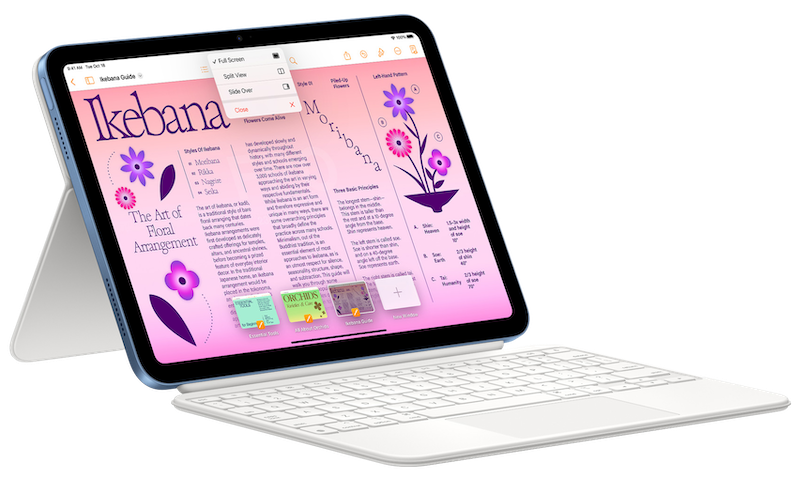
The iPad supports the first-generation Apple Pencil with an adapter to charge and pair it, but it also works with the USB-C Apple Pencil that was released in October 2023. The 10th-generation iPad also comes alongside the all-new Magic Keyboard Folio, which offers full-size keys with 1 mm of travel, a multi-touch trackpad, a function row, a two-piece design, and a kickstand back cover.
The iPad starts at $449 for 64GB of storage and is available for purchase from the Apple online store and Apple retail stores. The original Apple Pencil is available separately for $99, as is the USB-C Apple Pencil, priced at $79. The Magic Keyboard Folio is sold separately too for $249.
Note: See an error in this roundup or want to offer feedback? Send us an email here.
How to Buy
The 10.9-inch 10th-generation iPad can be purchased from the online Apple Store and Apple retail stores. The 64GB storage option is priced at $449, with 256GB of storage available for $599. Cellular models are also available at an additional cost.
Reviews
Reviews of the 10th-generation iPad were generally positive. The Verge's Dan Seifert said the 10th-generation iPad sits in an awkward position between the iPad Air and the ninth-generation iPad:
In a vacuum, there's very little to complain about with the 10th-gen iPad. It's an excellent tablet that does all of the things you expect from a tablet very well. Even though its screen isn't as good as other iPads, it's still good enough, and its performance is unimpeachable. If this was the only iPad Apple sold, many people would buy it and be perfectly happy with it. But in context with the many other iPads that Apple sells, I'm not sure why you'd pick this one. If cost is a factor, you're buying an iPad for a kid, or need a headphone jack, the still-available and much less expensive ninth-gen model is the one to go with. For a lot of people, the ninth-gen model is the better iPad for their needs. If you want the bigger screen and more modern design, the iPad Air is right there with its better display, even faster processor, and better accessory landscape, and you can frequently get it for less than $100 more than the new iPad.
WIRED's Brenda Stolyar also felt the new iPad sits in an odd spot in the lineup:
When you crunch the numbers, reality sets in. The affordable and plenty-capable iPad that used to start at $329 has now been hiked up to $449. That's without the added cost of accessories (Apple charges $249 for the Keyboard Folio). It's tough to justify a $120 price hike over its predecessor—especially when one of the "upgrades" is the removal of the headphone jack. It doesn't help that Apple is continuing to sell the ninth-gen iPad for $329, and you can typically find the iPad Air for roughly $519 at retailers like Amazon. The 10th-gen tablet sits in an odd spot.
CNET's Scott Stein praised the new landscape FaceTime camera:
The one big thing I wanted from the iPad arrived, like a magic wish granted: The weirdly placed front camera on the iPad is now on the landscape edge. This is great. Why is this great? Because I work on iPads in landscape mode, in cases and stands and keyboard docks. When I Zoom or FaceTime on other iPads, my face looks weirdly off-angle with my eyes looking elsewhere. That's fixed now. Combined with the auto-zooming Center Stage tech, this iPad's video chat camera is absolutely perfect.
Tom's Guide's Mark Spoonauer shared benchmark results showing that the A14 Bionic chip in the new iPad is up to 30% faster than the A13 chip in the previous model:
On Geekbench 5, which measures overall performance, the iPad 2022 scored 1,580 on single-core and 4,400 on multi-core, which is a marked improvement over the 1,384 and 3,387 turned in by the 9th gen iPad. However, the iPad Air with its M1 chip scored a much higher 1,707/7,151.
TheStreet's Jake Krol pointed out that beyond the 10th-generation iPad requiring an adapter to charge and pair the first-generation Apple Pencil, the device is a good buy, but he still recommends considering the ninth-generation iPad for its value:
The oddities come with the first-generation Apple Pencil support. I'm all for the move to USB-C, but it's not the most Apple-like experience for charging it. There's also the fact that the adapter is pretty hard to come by right now. But if you can look past that, it's an excellent iPad and if you're someone who's looking to swim between iPad tasks and more advanced ones, this is an excellent choice. The $449 price tag also includes 64GB of storage which is clutch. It can also be paired with the $249 Magic Keyboard Folio for a laptop-like experience that really lets you get work done here. And when it's time to play just detach the keyboard. Of course though, you have to consider the 9th Gen iPad which still offers stellar performance and frequently falls below the $329 price tag. If you're not after the modern build of the 10th Gen or the new folio covers, that might be the best option for you.
Design
Apple overhauled the design of the low-cost iPad with the launch of the 10th-generation model, introducing a new look that's similar to the iPad Pro and the iPad Air. The iPad no longer has thick top and bottom bezels with a Touch ID Home button, instead adopting an all-display design.
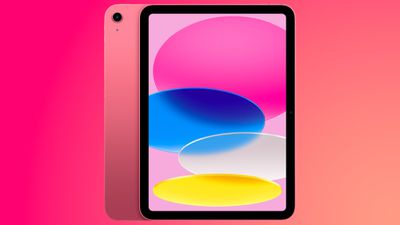
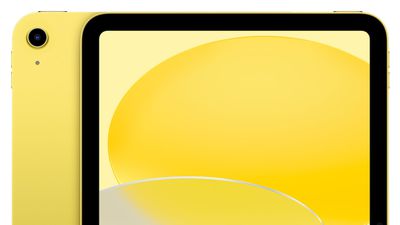
There is an edge-to-edge display with slim bezels and an aluminum chassis with flat, rounded edges, much like the iPad Air. It comes in four colors, including blue, pink, silver, and yellow.
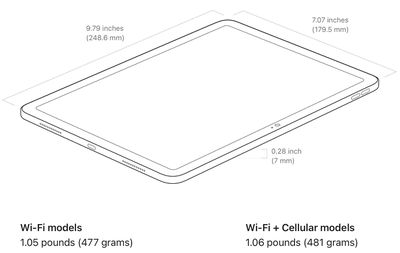
The iPad measures in at 9.79 inches (248.6 mm) long, 7.07 inches (179.5 mm) wide, and 0.28 inches (7 mm) thick. It is just a bit bigger than the iPad Air, but a good deal thicker than its 6.1-mm sibling. It weighs in at 1.05 pounds (477 grams) with cellular models weighing just a few grams more.
Though there is an all-display design, the iPad does not use Face ID. Like the iPad Air and the iPad mini, it has a Touch ID fingerprint sensor built into the power button. The fingerprint sensor scans the finger much like a Touch ID Home button, but it is smaller and more compact. Touch ID can be used to unlock the iPad, access apps, make purchases with Apple Pay, and more.
There is a single-lens camera at the back of the iPad, along with speakers at the top and bottom, a microphone at the back, volume up and down buttons at the side, and a Smart Connector along the side edge for accessories. Cellular models have a nano-SIM tray.
The 10th-generation iPad uses USB-C for the first time, with Apple transitioning away from Lightning across all iPad models. There is a landscape front-facing camera on the right side, and this marks the first time that Apple has installed a horizontally optimized camera in an iPad.
Display
The iPad has a 10.9-inch Retina LED display with a resolution of 2360 x 1640 at 264 pixels per inch. It is the least advanced display compared to the iPad Pro, iPad Air, and iPad mini models, which is how Apple keeps the iPad affordable.
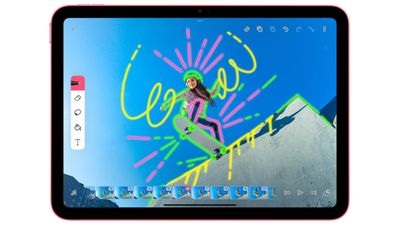
Apple has increased the size of the iPad's display with the elimination of the Home button, but it continues to feature 500 nits brightness. It offers True Tone support, which allows the temperature of the display to change to be warmer or cooler, matching the lighting in the room that you're in so there's not a stark difference between the color of the display and the ambient light.
The display is also equipped with a touch sensor that allows it to work with the first-generation Apple Pencil, and it has a fingerprint-resistant oleophobic coating.
A14 Bionic Chip
The iPad is equipped with an A14 chip that was first used in the iPhone 12 lineup. The A14 brings a 20 percent increase in CPU performance and a 10 percent improvement in GPU performance over the prior-generation A13 chip.
There is also a 16-core Neural Engine, which has double the cores of the A13 for an 80 percent boost to machine learning capabilities.
RAM
The 10th-generation iPad includes 4GB RAM, up from 3GB in the prior-generation model.
Storage
Apple offers the iPad in 64GB and 256GB size options, with no 128GB model available.
Battery Life
The iPad is equipped with a 28.6-watt-hour lithium-polymer battery that is smaller than the battery in the ninth-generation iPad, but it continues to offer up to 10 hours of battery life when surfing the web or watching video.
Rear Camera
Apple added an upgraded 12-megapixel Wide camera to the iPad, which is the same camera that's in the iPad Air. It has an ƒ/1.8 aperture, Smart HDR 3 support, Burst mode, Live Photos with stabilization, autofocus with Focus Pixels, wide color capture, exposure control, auto image stabilization, noise reduction, and more.
4K video recording is supported at 20, 30, or 60 frames per second, as is slo-mo video at 120 or 240 frames per second. The iPad can also record in 1080p at 30 or 60 frames per second, and it supports continuous autofocus, cinematic video stabilization, and the option to take 8-megapixel still photos when recording 4K video.
FaceTime Camera
Though there's no TrueDepth camera system to support Face ID in the iPad Air, there is a 12-megapixel Ultra Wide front facing camera with a 122 degree field of view and an ƒ/2.4 aperture. The camera supports Center Stage, designed to keep users perfectly framed on screen during video calls. With the wider field of view, the camera can zoom in as appropriate and follow people around the room as they move.

When other people join in on a call, the camera is able to detect them, and it will zoom out to fit everyone into the view. Center Stage is designed for FaceTime, but it also works with third-party video apps like Zoom and Skype.
The camera is positioned on the side of the iPad so that it is upright when in a landscape orientation, similar to the camera on a MacBook. This is the first time that Apple has used this particular camera orientation.
Other Features
5G
Cellular models of the 10th-generation iPad have a 5G chip that allows them to connect to 5G networks, but it does not support the fastest mmWave 5G networks and is limited to the slower but more widespread Sub-6GHz networks.
mmWave 5G networks are the fastest 5G networks, but mmWave is short-range and can be obscured by buildings, trees, and other obstacles, so its use is limited to major cities and urban areas along with venues like stadiums, arenas, airports, and other places where a lot of people congregate. Sub-6GHz 5G is much more widely available and available in urban, suburban, and rural areas across the United States and other countries.
There are two SIM options in the iPad: a physical nano-SIM slot at the side of the device and an eSIM, or digital SIM, which is designed to work without the need for a physical SIM card.
Apple in September 2023 announced a new version of the iPad 10 that is available in mainland China. The new 10th-generation iPad includes eSIM support, and it is the first eSIM device available in the country.
Wi-Fi, Bluetooth, and Sensors
The iPad supports 802.11ax Wi-Fi 6 and Bluetooth 5.3. The iPad includes a three-axis gyro, an accelerometer, an ambient light sensor, and a barometer.
USB-C Port
The iPad is equipped with a USB-C charging port, and this is the first time that Apple has used USB-C for the low-cost iPad option. Prior models used Lightning connectors.
The USB-C port in the 10th-generation iPad is slower than the USB-C port available in the iPad Pro, iPad Air, and iPad mini models. It is limited to USB 2.0 speeds of up to 480Mb/s for data transfer.
Accessories
Apple Pencil
The iPad is compatible with both the $99 original Apple Pencil and the $79 USB-C Apple Pencil that Apple announced in October 2023.

The Apple Pencil is a stylus that's designed to offer unparalleled precision and integration with the iPad while also offering a natural feel that's similar to the sensation of using a pen or pencil on paper.
There are pressure and positioning sensors built into the original Apple Pencil to allow it to detect a range of forces for pressure-sensitive drawing and writing, but this feature is not available in the USB-C Apple Pencil. Two tilt sensors in the tip of the Apple Pencil determine the orientation and angle of the hand holding it, enabling shading techniques.
The Apple Pencil offers a 12-hour battery life and it charges through the built-in Lightning connector at the bottom of the device. A 15-second charge delivers a half-hour of power, so it's always going to have juice when needed.
Because the first-generation Apple Pencil charges using an integrated Lightning connector, to charge it with the iPad, a Lightning to USB-C adapter is required. The USB-C Apple Pencil has a hidden USB-C port so it will need a USB-C cable to charge.
Magic Keyboard
Apple sells a $249 Magic Keyboard Folio alongside the iPad, with the accessory able to turn the iPad into a mini notebook. It is a full-size keyboard with a built-in trackpad and a 14-key function row.
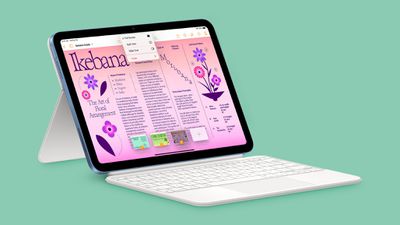
The keyboard features two pieces, so a cover and kickstand can be used separately from the detachable keyboard. Both pieces magnetically attach to the iPad.
2021 Ninth-Generation iPad
Apple's ninth-generation iPad, first introduced in September 2021, continues to be available for the same starting price of $329. It introduced the A13 Bionic chip, True Tone, a better front-facing camera with Center Stage, and more.
The ninth-generation iPad looks the same as previous models with an aluminum body that is slightly thicker than the iPad Air and iPad Pro models.
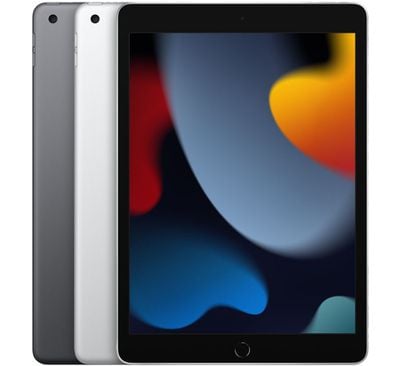
As with the seventh- and eighth-generation iPad, the ninth-generation iPad offers a 10.2-inch display, which offers more viewing area than the 9.7-inch iPad that was sold a few years prior. The 10.2-inch iPad is Apple's smallest iPad display after the 8.3-inch iPad mini. The 10.2-inch display has a resolution of 2160 x 1620 at 264 pixels per inch and it offers nearly 3.5 million pixels along with 500 nits brightness.
The iPad features Apple's A13 Bionic chip, which was first introduced with the iPhone 11 and iPhone 11 Pro in 2019. While it is slower than the M1 chip in the iPad Air, it is much faster than the A12 chip that was in the previous-generation entry-level iPad.
The iPad also offers a 12-megapixel Ultra Wide front-facing camera with a 122º field of view and an ƒ/2.4 aperture, which is a major upgrade from the previous 1.2-megapixel FaceTime camera. The front-facing camera also supports Center Stage to keep subjects in frame during video calls.
Other iPad features include an 8-megapixel camera with 1080p video recording, Gigabit-class LTE for cellular models, an "all-day" 10 hours of battery life, Touch ID, Apple Pay support, and 802.11ac WiFi. First-generation Apple Pencil support is included, and there's a Smart Connector so the iPad works with the Smart Keyboard Folio for the 10.2-inch iPad.
The ninth-generation iPad continues to be positioned as an affordable, entry-level tablet for educational institutions and those on a budget, with prices that start at $329 or $299 for Apple's educational institution customers.
Available in Silver and Space Gray, the iPad starts at $329 for 64GB of storage or $479 for 256GB of storage and is available for purchase from the Apple online store and Apple retail stores. Cellular models are available with an additional $130 charge. The Apple Pencil is available separately for $99, as is the Smart Keyboard, priced at $159.
What's Next for the iPad
An 11th-generation low-cost iPad is rumored to be launching in late 2024 at the earliest. We are expecting the next iPad to include a faster A15 chip, an improvement over the A14 chip in the current model.